Did Sejong Create Hangul Because of China? Kim Jin-myung’s View on Sejong’s Insight
This video features novelist Kim Jin-myung, known for faction-style storytelling, and discusses the background, historical interpretation, and major ideas behind his new work The Nation of Sejong. The source frames the book as an attempt to look beyond official records and explore what the author calls the substantive truth hidden behind history.
Did Sejong Create Hangul Because of China? Kim Jin-myung’s View on Sejong’s Insight
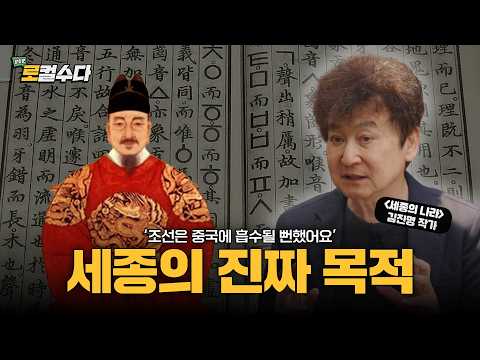
Original YouTube source thumbnail
Quick Summary
This source introduces novelist Kim Jin-myung’s interpretation of King Sejong and the creation of Hangul through his new novel, The Nation of Sejong.
The discussion presents Hangul not as a simple visual imitation, but as a rational and scientific writing system created through Sejong’s independent insight.
The source emphasizes Sejong’s struggle to give ordinary people a tool for communication despite opposition from the ruling elite.
Main Summary
This video features novelist Kim Jin-myung, known for faction-style storytelling, and discusses the background, historical interpretation, and major ideas behind his new work The Nation of Sejong. The source frames the book as an attempt to look beyond official records and explore what the author calls the substantive truth hidden behind history.
Kim explains his view of faction writing as a method that uses fiction to approach deeper historical possibilities. According to the provided summary, he argues that records from the Joseon period could reflect the perspective of winners or power holders, so history may need to be reinterpreted through rational inference.
A major focus of the discussion is the creation of Hangul. The source presents Kim’s view that King Sejong did not create Hangul through the collective work of Jiphyeonjeon scholars, but studied and completed it largely on his own. In this interpretation, many ruling elites of the time were deeply attached to Neo-Confucianism and Chinese cultural authority, making it difficult for Sejong to openly depend on them for a writing system intended for ordinary people.
The video also explains why Sejong created Hangul. According to the summary, early Joseon was under the strong influence of scholar-officials who upheld cultural submission to Ming China. Kim interprets Sejong’s creation of Hangul as a national project to give the people literacy and strengthen the foundation of independence. In this view, Hangul was not merely a script, but a tool that gave power to the people.
The discussion also highlights Hangul’s scientific structure. Kim describes Hangul as a highly efficient writing system built from simple strokes and circles, with broad combinational potential for representing sounds. The video connects this structure to modern questions of literacy recovery and cultural pride.
KGATE30 INSIGHT
KGATE30’s guidepost for this source is this question: was Hangul simply a writing system, or was it also Sejong’s strategy for national independence and public empowerment?
For international readers, the important point is that this source is not presenting a neutral academic paper. It is an interview with a novelist who uses historical imagination and rational inference to reinterpret Sejong’s motivations. The value of the source lies in how it connects Hangul, cultural independence, literacy, and the political courage of a ruler who wanted ordinary people to communicate.
This page does not decide whether every claim in the interview is historically settled. It helps readers understand the argument being made: that Hangul can be read as a scientific and cultural project created against the pressure of elite opposition and dependence on Chinese cultural authority.
Cultural Context
Context Note 1
King Sejong is one of the most respected figures in Korean history, and Hangul is central to Korean cultural identity. For many Koreans, Hangul is not only a writing system but also a symbol of accessibility, literacy, and national selfhood.
Context Note 2
The source connects Hangul to the political and cultural situation of early Joseon. At that time, Chinese writing and Neo-Confucian learning had strong authority among the ruling class. A new writing system for ordinary people could be seen as disruptive because it gave communication power to people outside the elite written culture.
Context Note 3
Kim Jin-myung’s interpretation adds a literary layer to this history. Instead of treating Hangul only as a linguistic invention, the discussion frames it as a civilizational decision: Sejong’s attempt to help people read, speak, and participate in the nation through a script designed for them.
Knowledge Bridge: Timeline
Source
2:57-7:54: Kim Jin-myung explains his approach to faction writing and the idea of using fiction to explore substantive truth beyond records.
Source
11:34-15:37: The discussion presents the view that Sejong created Hangul through his own research rather than relying mainly on Jiphyeonjeon scholars.
Source
15:37-18:33: The source explains why Sejong may have created Hangul as a tool for public empowerment and national independence.
Source
19:16-22:09: Kim describes Hangul’s scientific structure, built from simple strokes and circles with wide combinational potential.
Source
Overall: The discussion links Sejong’s insight, Hangul’s design, literacy, and cultural pride.
FAQ
Q1. What is this video mainly about?
It is an interview and discussion with novelist Kim Jin-myung about his book The Nation of Sejong and his interpretation of King Sejong’s creation of Hangul.
Q2. Does the source say Hangul was created because of China?
The source presents the idea that Sejong created Hangul partly to move beyond cultural dependence on Chinese authority and to strengthen the independence of the people and the state.
Q3. Does this page claim Kim’s interpretation is settled historical fact?
No. This page presents the argument as the source’s interpretation. It does not independently verify every claim.
Q4. What role does fiction play in this source?
Kim explains that faction uses fiction to explore what he sees as substantive truth behind records, especially when official history may reflect the perspective of power.
Q5. Why is Hangul described as scientific?
According to the source summary, Kim emphasizes Hangul’s simple structural elements, efficient combinations, and broad ability to represent sounds.
Key Terms
King Sejong
The Joseon king associated with the creation of Hangul.
Hangul
The Korean writing system discussed as a scientific and public-oriented script.
Kim Jin-myung
The novelist featured in the source video.
The Nation of Sejong
Kim Jin-myung’s new novel discussed in the interview.
Faction
A genre combining fact and fiction to reinterpret historical questions.
Jiphyeonjeon
The scholarly institution often associated with Sejong’s reign.
Cultural independence
The idea that Hangul helped Korea move beyond dependence on Chinese written culture.
Literacy
The ability of ordinary people to read and communicate through writing.