May 16 and Park Chung-hee’s Long Rule: A Conservative Modernization Thesis
This source presents a strongly conservative interpretation of South Korea’s modern political development. It argues that the May 16 military takeover should not be understood only as a coup, but as a modernization revolution that reorganized the foundations of the Korean state. According to the provided summaries, the lecture frames Park Chung-hee’s rule as a historical instrument for overcoming poverty, corruption, weak national capacity, and geopolitical insecurity.
Original Source
May 16 and Park Chung-hee’s Long Rule: A Conservative Modernization Thesis
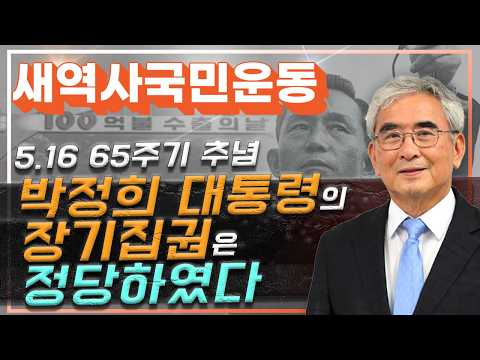
Original YouTube source thumbnail
Quick Summary
This lecture presents the May 16 military takeover not simply as a coup, but as a modernization revolution.
It argues that Park Chung-hee’s long rule was justified by national development, export-led growth, anti-communism, and self-reliant defense.
The lecture criticizes the opposition’s mass-economy theory as unrealistic and interprets the Yushin system as a response to institutional limits.
The source represents a conservative historical view that asks modern Koreans to re-evaluate democratization narratives through the lens of state-building.
Main Summary
This source presents a strongly conservative interpretation of South Korea’s modern political development. It argues that the May 16 military takeover should not be understood only as a coup, but as a modernization revolution that reorganized the foundations of the Korean state. According to the provided summaries, the lecture frames Park Chung-hee’s rule as a historical instrument for overcoming poverty, corruption, weak national capacity, and geopolitical insecurity.
The lecture begins with the revolutionary pledges announced after May 16. These pledges included anti-communism, strengthening the U.S.-ROK alliance, eliminating social corruption, solving livelihood problems, rebuilding the economy, and cultivating national capability. The speaker argues that these pledges were not empty slogans, but long-term state-building goals that shaped South Korea’s next decades.
A central part of the lecture is economic development. The source presents export-led industrial growth as proof that the May 16 project produced concrete results. It also praises the Saemaul Movement as a major social transformation project that changed rural consciousness and reorganized village communities. In this interpretation, Park Chung-hee’s government is not framed mainly as an authoritarian regime, but as a development state that mobilized society toward modernization.
The lecture also directly criticizes the opposition. It describes the opposition’s mass-economy theory as detached from the real structure of the world market and trapped in dependency-style thinking. From that perspective, strong centralized leadership is presented as necessary, not merely oppressive. The third-term constitutional amendment and the October Yushin system are interpreted not as simple power greed, but as attempts to break through institutional limits that blocked long-term national projects.
Finally, the lecture turns to present-day Korea. It argues that short presidential terms and constitutional restrictions can produce inefficient political conflict in developing states. It also calls on modern Koreans to reconsider democratization-centered historical narratives and to re-evaluate the value of strong and competent leadership. The source therefore does not merely defend Park Chung-hee as an individual; it constructs a broader theory of political authority, development, and historical legitimacy.
KGATE30 INSIGHT
KGATE30’s core reading is that this source is not only a defense of Park Chung-hee. It is a complete conservative theory of modernization. The lecture turns May 16 into a founding rupture, Park’s long rule into a state-building mechanism, and authoritarian concentration into a developmental necessity.
The deeper structure is a clash between two historical grammars. One grammar reads modern Korean history through democracy, constitutionalism, civil resistance, and the moral cost of dictatorship. The other grammar, represented by this lecture, reads the same period through poverty escape, anti-communist survival, export growth, institutional discipline, and state capacity. The lecture’s argument is powerful precisely because it does not deny authoritarian rule; instead, it tries to subordinate that problem to the larger claim of national modernization.
The key point is that the lecture transforms “long rule” from a democratic problem into a developmental tool. It asks the audience to judge political power not by procedural limits alone, but by historical output: growth, defense, rural transformation, and national capability. That makes this source a gateway into one of the sharpest conflicts in Korean modern historical memory: whether state-led modernization can justify the concentration of power, and whether democratic legitimacy can be separated from developmental performance.
KGATE30 does not present this as a final verdict. The value of this source is that it clearly reveals a conservative historical framework that still competes with democratization-centered interpretations of modern Korea.
Cultural Context
Context Note 1
For Korean readers, May 16 remains one of the most divisive events in modern history. It can be remembered as a military coup that interrupted constitutional democracy, or as a forced modernization project that accelerated state capacity and economic development. This source belongs firmly to the second interpretation.
Context Note 2
For international readers, this lecture helps explain why Park Chung-hee remains a contested figure. The debate is not only about whether he ruled for too long. It is also about how a poor, divided, Cold War state should be judged: by liberal democratic standards, by developmental achievement, by security pressure, or by the sacrifices imposed during modernization.
Context Note 3
The source also shows how historical memory becomes political philosophy. It does not simply say “Park Chung-hee was right.” It argues that strong leadership, long-term planning, and institutional concentration can be historically justified when the nation faces poverty, security crisis, and weak state capacity. This is why the lecture functions as both a history lecture and a political argument.
Knowledge Bridge: Timeline
Source
1961: The May 16 military takeover occurs and is framed by the lecture as a modernization revolution.
Source
After May 16: Six revolutionary pledges are presented as the foundation of a long-term state-building project.
Source
Park Chung-hee era: Export-led growth and self-reliant defense are interpreted as evidence of successful national transformation.
Source
Saemaul Movement period: Rural modernization is described as a major social reconstruction effort.
Source
Third-term amendment and October Yushin: The lecture frames these as institutional breakthroughs for long-term national projects.
Source
Present-day Korea: The source calls for a re-evaluation of democratization-centered narratives and stronger appreciation of capable leadership.
FAQ
Q1. What is this video about?
It is a lecture arguing that the May 16 military takeover should be understood as a modernization revolution and that Park Chung-hee’s long rule was historically justified.
Q2. Does the source describe May 16 as a coup?
The source does not focus on the coup interpretation. It instead frames May 16 as a revolutionary break that enabled modernization and state-building.
Q3. How does the lecture justify Park Chung-hee’s long rule?
It argues that long-term leadership was necessary for export-led growth, national defense, rural transformation, and the implementation of state projects.
Q4. How does the lecture view the opposition?
It criticizes the opposition’s mass-economy theory as unrealistic and insufficient for South Korea’s position in the world market.
Q5. Why is this source controversial?
Because it challenges democratization-centered interpretations and presents authoritarian concentration as a historically necessary tool for national development.
Key Terms
May 16 military takeover
The 1961 seizure of power that the source frames as a modernization revolution.
Park Chung-hee
South Korean leader whose long rule is defended in the lecture.
Modernization revolution
The lecture’s interpretation of May 16 as a transformative state-building event.
Export-led growth
Economic strategy presented as evidence of successful national development.
Saemaul Movement
Rural modernization movement praised by the source as social reconstruction.
Yushin system
Political system interpreted by the lecture as an institutional tool for long-term national projects.
Mass-economy theory
Opposition economic idea criticized by the source.
Strong leadership
The central political value defended by the lecture.
Democratization narrative
The historical framework the lecture asks viewers to reconsider.
State capacity
The ability of the state to mobilize society, develop the economy, and secure national defense.